Golf back pain

Your back hurts. Your hips are usually the reason.

Low back pain is the most common complaint in golf. It is also the most commonly mistreated — because the sore segment is rarely the segment that failed. We screen the whole chain, treat what is actually restricted, and rebuild a swing your back can handle.

What's actually going on

Four physical limits that push load into your low back

The golf swing asks for a lot of rotation in a short window. When a joint above or below the lumbar spine will not give it up, the spine borrows the range — and pays for it.

Limited hip internal rotation

If your lead hip cannot turn through impact, the pelvis stops rotating and the lumbar spine takes over the turn. It is one of the most common findings in golfers with recurring low back pain, and it often shows up as early extension or a slide off the ball.

A stiff thoracic spine

Your mid-back is built to rotate; the lower back is not. When thoracic rotation is restricted, the shoulder turn has to come from somewhere — usually the lumbar segments and the trail-side facet joints that ache after a round.

Poor core and pelvic control

Rotational speed without the ability to brace means the spine absorbs force it should be transferring. Loss of posture, reverse spine angle and S-posture patterns all trace back to control, not effort.

Restricted ankles and a weak base

Ground force starts at your feet. Limited ankle dorsiflexion or a weak trail leg changes how you load and unload, pushing compensations up the chain into your back.

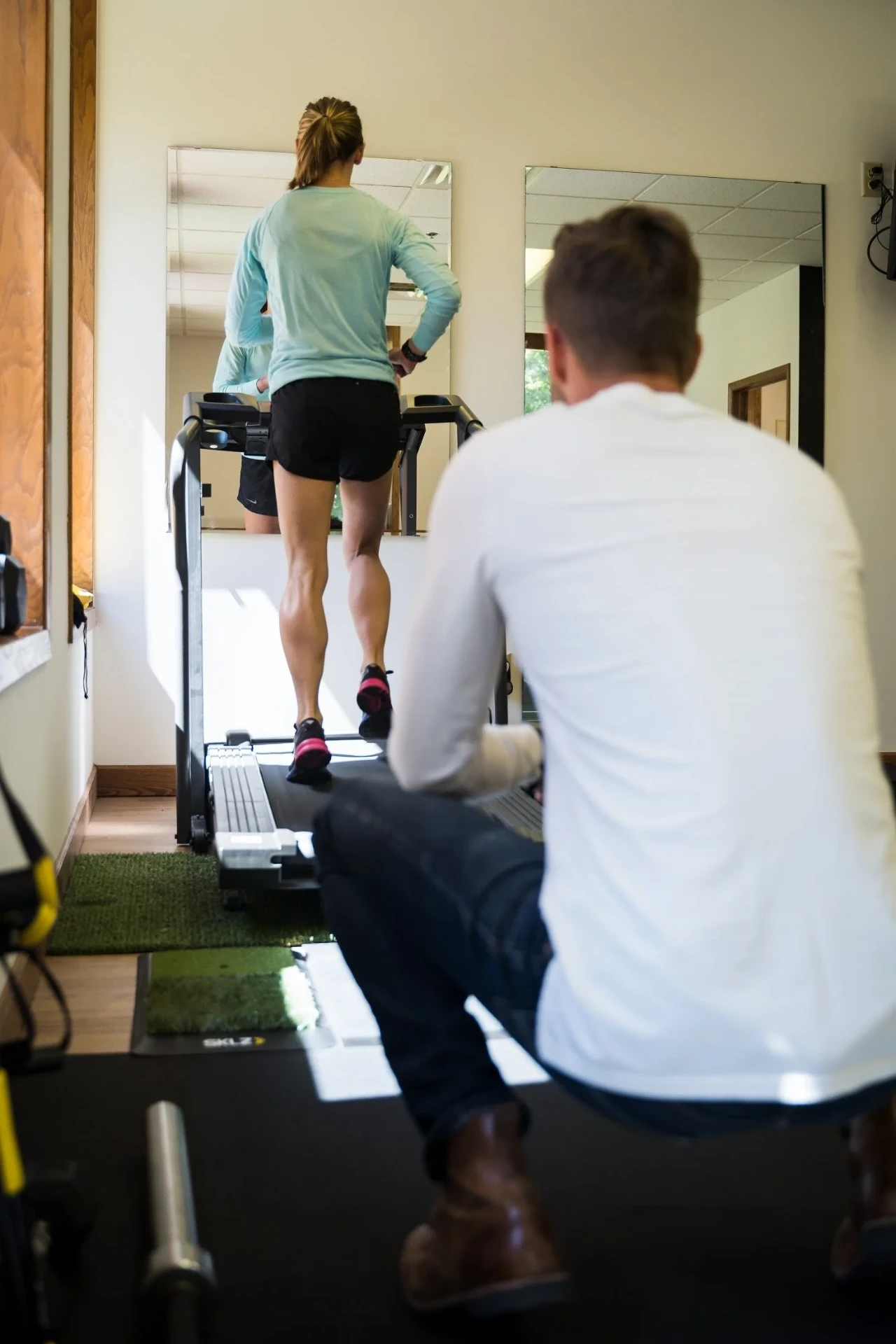
Physical therapist observing a movement assessment on a treadmill

How we treat it

From painful round to full 18

  1. 01

    Find the real driver

    A full-hour evaluation: symptom history, a lumbar and hip exam, and a golf movement screen of the hips, thoracic spine, shoulders and ankles — then we match those findings to your swing.

  2. 02

    Calm the painful tissue

    Hands-on manual therapy, joint mobilization, dry needling and soft tissue work where indicated, so you can move enough to start rebuilding.

  3. 03

    Restore the missing rotation

    Targeted mobility for the hips and mid-back, paired with loaded strength work so the new range holds up under swing speed instead of disappearing by the next round.

  4. 04

    Return to a full round

    A graded ladder from chipping to range work to 18 holes, with clear criteria at each stage and a warm-up you will actually do.

What you get

Care built around the golfer, not the ache

60 min

One-on-one every visit

Your therapist for the full hour — evaluation, hands-on treatment and coaching, never handed off to an aide.

Hips first

We treat the cause, not just the ache

The back is where it hurts. The hips, mid-back and ankles are usually why.

18 holes

The goal is a full round

Discharge means playing again without bracing for the back nine, not just being pain-free on the table.

Come in sooner if you notice

  • Pain that starts on the trail side late in a round
  • Stiffness the morning after you play
  • Losing your posture or sliding through impact
  • Distance dropping while your swing feels the same
  • Pain that travels into the hip, glute or leg

Not sure where to start? If you are in pain, book an evaluation. If you are pain-free but losing rotation, start with the golf movement screen.

Already out of pain? Keep it that way with golf performance training that builds rotational strength and speed.

Direct access: in Massachusetts you can begin physical therapy without a physician referral.

FAQs

Golf back pain questions

Still unsure? Call 774-436-5558 and we'll talk it through — no front desk, you'll reach your therapist.

Why does my lower back hurt after golf?
In most golfers the back is where the pain shows up, not where the problem starts. When the hips cannot rotate, the mid-back is stiff, or the trail ankle will not bend, the lumbar spine makes up the difference — rotating and side-bending under load hundreds of times a round. Treating only the sore area rarely holds; restoring rotation above and below it does.
Should I stop playing until my back settles down?
Usually not completely. We would rather modify volume — fewer range balls, shorter rounds, warm-up changes — while we treat, so you keep playing and keep your season. Full rest is reserved for the small number of presentations that genuinely need it.
Is this a disc problem?
Sometimes, often not. Golf-related back pain is more commonly a movement and load problem than a structural one, and imaging findings are common in people with no pain at all. Your evaluation sorts out which pattern you have and whether referral for imaging is warranted.
How many visits does it usually take?
That depends on how long the pain has been there and how much rotation you have lost. Most golfers feel a meaningful change within the first few visits and continue on a plan that rebuilds strength and speed rather than stopping at pain relief.
Do I need a referral from my doctor?
No. Massachusetts has direct access, so you can start physical therapy without a physician referral. Call 774-436-5558 and we will tell you what your visit will cost before you book.
Can you work with my swing coach?
Yes, and we prefer it. With your permission we send your coach a short summary of what your body can and cannot do right now, so their lessons work with your physical limits instead of against them.

Next step

Ready to play pain-free golf?

Start with a full-body movement screen and a clear plan. Most golfers leave the first visit knowing exactly what is limiting their swing.